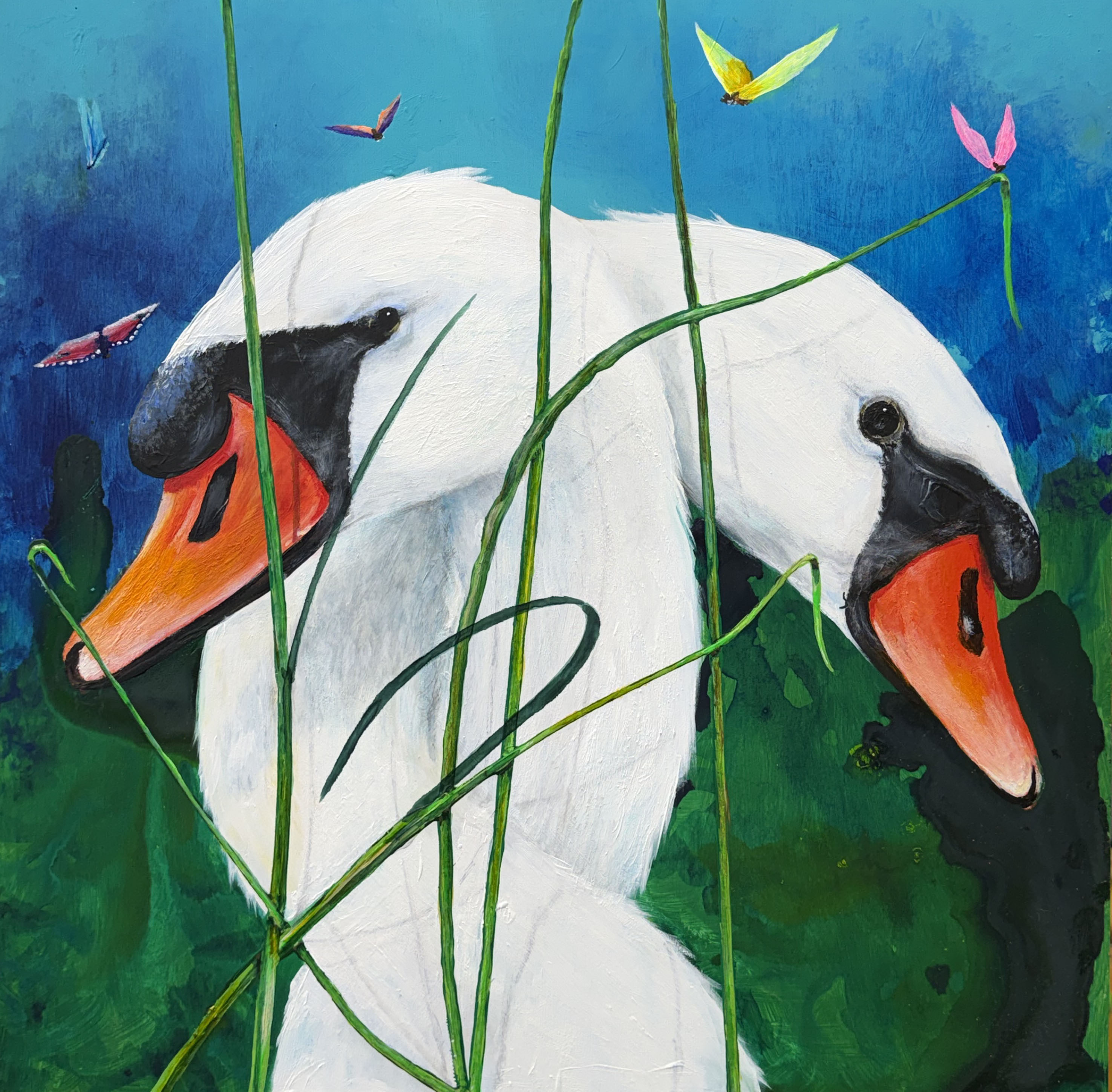
Let’s Hide
Two swans press into the reeds, their forms almost dissolving into the vertical rhythm of the grasses. At first glance, the scene feels tranquil – rich blues and greens, delicate insects suspended in the air – but beneath this calm sits a quiet instinct: concealment.
The birds are not simply resting; they are withdrawing. Their mirrored poses create a subtle tension, as if each is aware of the other’s need for shelter. The title, Let’s hide, introduces a shared, almost whispered decision – suggesting intimacy, complicity, and perhaps vulnerability.
The painting with its prestige framing, plays with visibility and obstruction. Slender reeds cut across the composition, interrupting the clarity of the swans’ forms, reminding us that nature rarely offers complete exposure. Beauty here is partially veiled, glimpsed rather than presented.
There is also a human echo. The work invites reflection on our own impulses to retreat – moments when the world feels too sharp, too watchful, and we instinctively seek cover, not in fear, but in preservation.
Softly surreal in its colour and composition, Let’s hide becomes less about wildlife and more about emotional refuge – quiet, shared, and deeply understood.
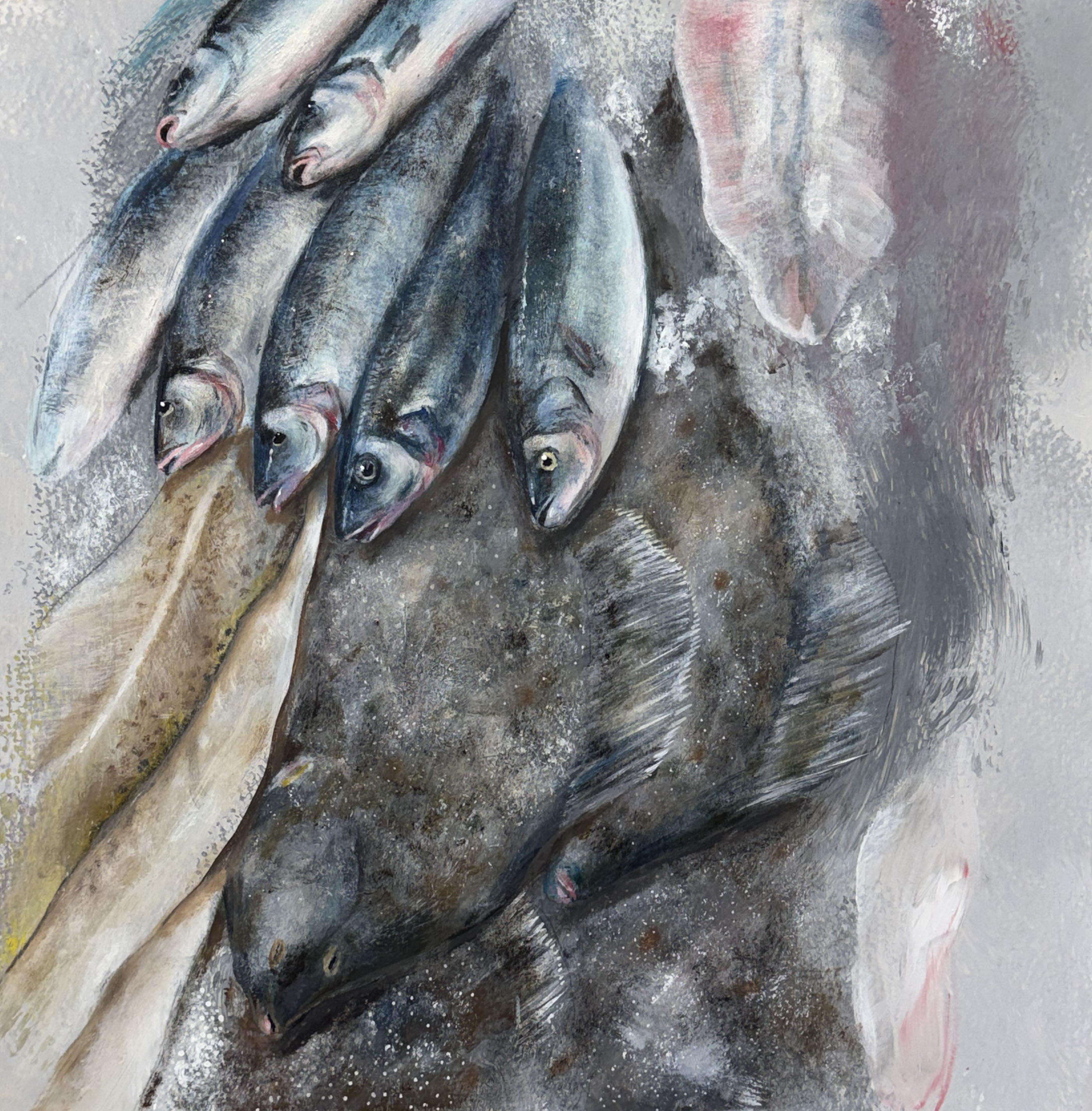
Market
A selection of freshly caught fish lies across a fishmonger’s slab, their bodies arranged with a practical familiarity that speaks of trade, routine, and daily life. The translucent sheen of water still clings to them, catching the light as if the sea has only just released its hold.
Above, a thin band of water cuts across the composition – less a literal environment than a visual echo of origin. It reminds us where these forms belonged moments before, creating a quiet tension between past movement and present stillness.
The painting with its prestige framing, resists the sentimentality often associated with still life. Instead, it leans into observation: the weight of the bodies, the subtle differences in species, the contrast between the sleek, suspended fish and the heavier flatfish settled below. Texture becomes language – scales, skin, moisture, and surface all rendered with an almost tactile immediacy.
Yet there is something more than documentation at play. The fish appear momentarily suspended between two states – no longer of the water, not yet fully reduced to commodity. Their presence feels paused, as if time has been briefly held in place.
In this way, the work recalls the long tradition of market still life, but with a contemporary sensitivity. It acknowledges the everyday reality of food and trade, while elevating it into something quietly contemplative – where beauty, utility, and transience sit side by side.
Beneath the Surface becomes a meditation on transition: from movement to stillness, from nature to commerce, from life to object – handled not with drama, but with a steady, unflinching gaze.

Norfolk Horse
In Norfolk Horse, Damian O’Connor pays tribute to the silent strength and sacrifice of the heavy horses used in war, work and heritage. Over one million of these animals served during the First World War, hauling artillery, supplies and lives across devastated landscapes. Here, their story is brought back into the public eye not through ceremony but presence.
Standing over ten feet tall, Norfolk Horse is greater than life-size by design, a monument not just to history but to endurance, loyalty and quiet power. Its weight, form and posture embody raw strength and stoic grace. This is not a sculpture of athleticism or showmanship. It is a figure of labour, burden and the nobility of service without glory.
But the story doesn’t end at the studio. Norfolk Horse appears at night, placed anonymously on roundabouts along the Broadland Highway encircling Norwich. Without fanfare or permission, it stands, temporarily and without announcement, as if it has returned of its own will. This guerrilla placement echoes Norfolk’s spirit of independence and the East Anglian character: rebellious, remote, with wild open skies and deep rural roots.
The horse has no name. This is deliberate. Each viewer is invited to project their own name, memory or meaning onto it, a tribute, a ghost, a guide. Its mute appearance speaks to the history of horses in this region: pulling brewing carts, tilling fields, racing in Newmarket and carrying soldiers into battle. Centuries of use and partnership, condensed into a single silhouette.
And though it may come and go without notice, the whispers remain. There is admiration. Recognition. Quiet respect. Norfolk Horse does not ask to be remembered. It simply stands, proud, patient and present, until it is gone again.
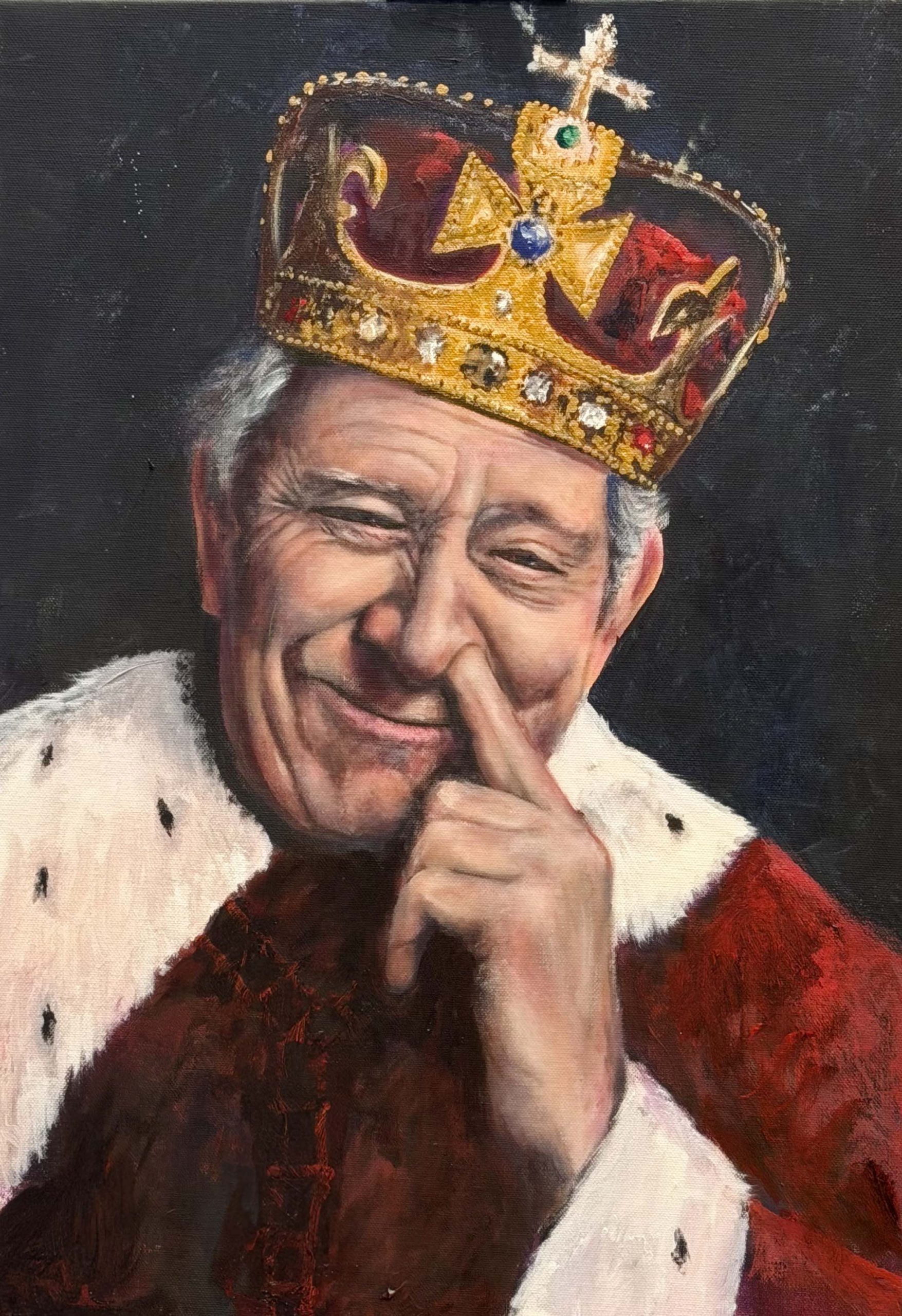
Untitled
This painting presents a moment of disarming humanity rendered almost absurd: King Charles, crowned and robed in full ceremonial authority, caught in an act so private, so unguarded, it collapses the distance between monarch and mortal.
The raised finger is not symbolic, not instructive, not reverent. It is simply doing what fingers sometimes do. And that is precisely the point.
By placing this small, faintly comic gesture at the heart of a composition saturated with regalia, the painting punctures the illusion of untouchable power. The crown glitters. The robes weigh heavily with history. Yet beneath them sits a man behaving exactly as any man might when he forgets he is being watched.
The expression matters. There is no embarrassment here — only quiet amusement, perhaps even complicity with the viewer. This is not satire aimed upward in anger, but humour aimed inward in recognition. The painting does not ridicule the monarch; it humanises him.
Set against a dark, almost reverential ground, the figure emerges not as an icon but as a person. The work invites the viewer to consider how easily authority dissolves when confronted with the stubborn ordinariness of being human.
In the end, the painting asks a gently destabilising question:
If even a king picks his nose, what, really, does the crown protect us from?
The answer is left hanging — somewhere between laughter and reflection.
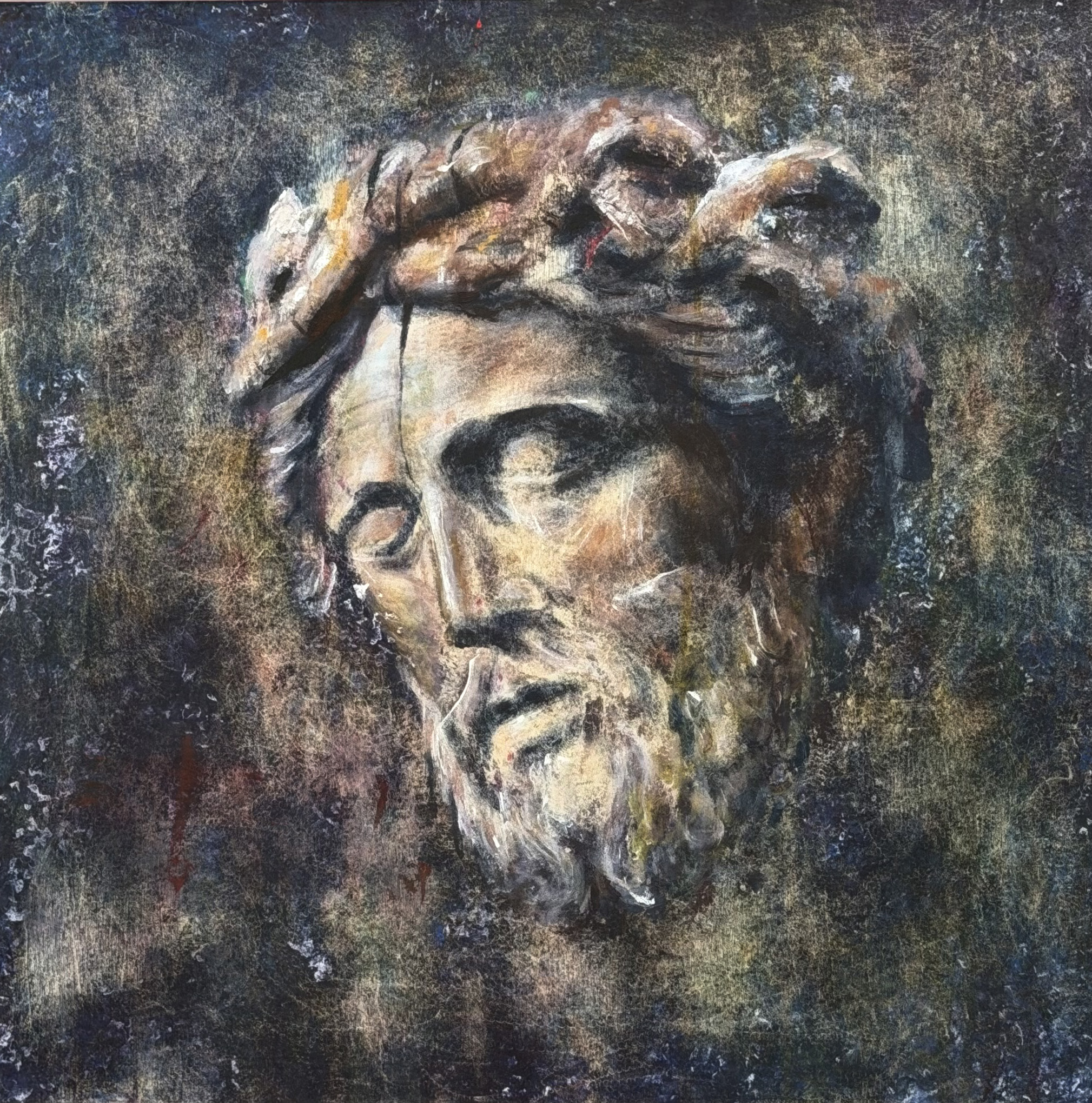
Untitled
In this work, Damian O’Connor confronts suffering, endurance and belief through a face that feels both ancient and immediate. Emerging from a weathered field of muted greys, ochres and ash, the crowned head appears worn by time rather than violence alone – a figure shaped as much by humanity as by divinity.
The crown of thorns is rendered not as spectacle, but as burden. There is no drama in the expression, only quiet resignation and immense stillness. The surface feels eroded, almost excavated, as though the image has been uncovered rather than painted. Scraped textures and softened edges suggest memory, decay and reverence existing side by side.
This is not an image of triumph or salvation. It is a meditation on endurance – on what it means to carry pain without spectacle, faith without certainty and sacrifice without audience. O’Connor strips the figure of narrative excess, leaving only presence: human, fragile and unavoidably real.
The painting asks not what we believe, but what we endure – and how much we ask others to bear in silence.
Mellow Yellow
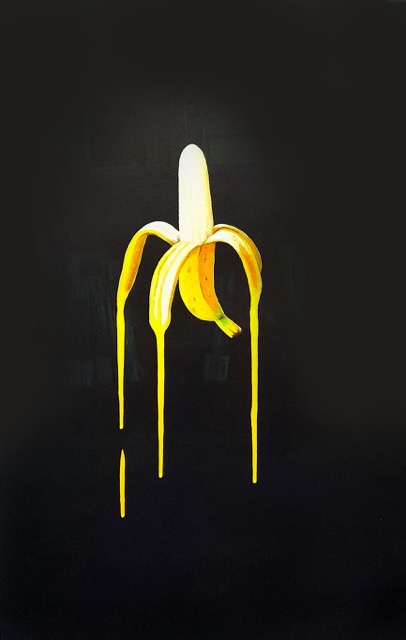
In Mellow Yellow, Damian O’Connor invites us to contemplate the beauty of design and the inevitability of decline. A single banana, mid-peel, hangs in isolation against a pitch-black backdrop. Its form is luminous, hyperreal yet it begins to drip, its perfection slipping away.
The banana is one of nature’s most extraordinary offerings: nutrient-rich, energy-giving, perfectly shaped for the hand. Its skin is both a shield and a signal, protective until peeled then instantly marking the countdown to spoilage. O’Connor captures that suspended moment between usefulness and decay, between certainty and loss.
Its flavour is famously consistent, its form familiar across continents. A fruit engineered by nature and refined by cultivation to offer reliable sweetness, soft texture and near-universal appeal. And yet, once exposed, its vulnerability is swift and irreversible.
Rendered with both wit and reverence, Mellow Yellow becomes a quiet but potent metaphor for time, fragility, consumption and trust. The painting’s visual restraint is deliberate; its meaning unfolds in layers, much like the fruit itself.
At approx. 2’6″ x 18″ and housed in a bespoke frame, this work is a succinct and powerful example of O’Connor’s ability to find philosophical weight in the everyday. It offers collectors a contemplative still life that hums with symbolism beneath its surface simplicity.
Blind Faith
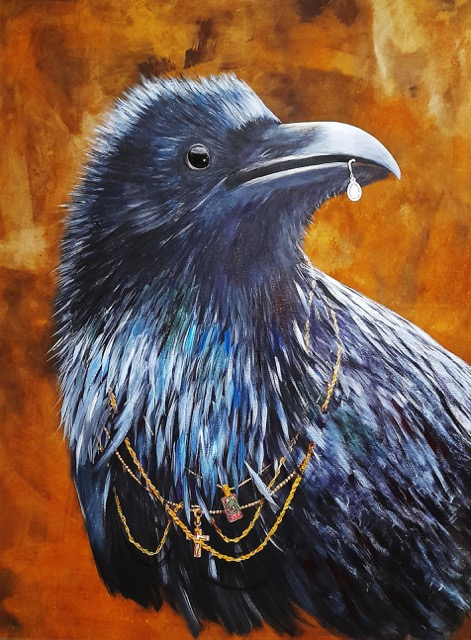
In Blind Faith, Damian O’Connor presents a portrait of unapologetic opportunism. A glossy-feathered crow dominates the canvas, clutching a diamond earring in its beak, its chest tangled with gold chains, religious symbols and tokens of cultural value. From crucifix to pendant nothing is off-limits, everything is collectible, wearable, claimable.
The bird is both beautiful and absurd. Its iridescent plumage is painted with O’Connor’s signature skill, shimmering with blues and violets against a scorched ochre background. But what draws us in is its posture: part thief, part king, part fool. The crow is adorned in borrowed status, each shiny object a prize with no understanding of meaning only desire.
This work is sharp satire about consumption, possession and the human (and avian) tendency to take without asking why. The result is uncomfortable, comical and confronting. Do we envy the crow’s treasures or pity its confusion?
With Blind Faith, O’Connor offers a warning in exquisite detail: the things we clutch most tightly may have the least true value.

Silent Watch
Silent Watch is an opulent celebration of the wild. Damian O’Connor composes a luminous scene alive with birdsong, subtle movement and watchful eyes. A host of birds, each painted with sharp precision and reverence, are scattered across a golden botanical lattice that pulses with pattern, energy and quiet anticipation.
Every bird is perched or paused mid-flight, alive to its surroundings. There is no chaos here, only alertness as though the entire canopy is holding its breath. The vine-like forms create rhythm and structure but nature’s randomness hums beneath. The palette moves from burnished golds to rich greens and deep shadows, echoing the shift from day into dusk or season into season.
The work is rich in detail but never still. It invites a second look, and a third, as tiny lives reveal themselves within the patterned tangle. The surface appears both ornamental and organic, like a precious textile embroidered by wind and instinct.
Set within an exquisitely carved gilded frame, Silent Watch becomes more than a painting, it is an artefact of devotion to wildness, light and vigilant presence. A rare harmony of painterly luxury and natural wonder.
Elegy in Gold
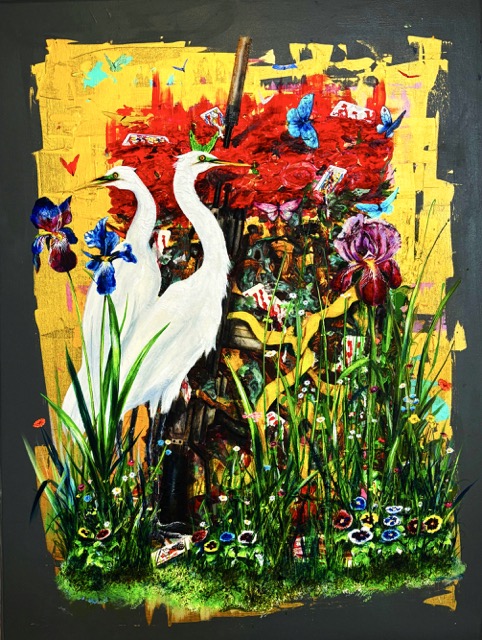
Damian O’Connor’s Elegy in Gold is a layered allegory of beauty and mortality, peace and violence. Two egrets, symbols of fidelity and grace, stand tall amidst a riot of wildflowers, blood-red roses and delicate irises. Between them, barely obscured, the outline of an AK47 assault rifle slices through the lush undergrowth, introducing a quiet but undeniable threat.
Scattered playing cards and drifting butterflies evoke the randomness of fate and transformation, while the golden backdrop fractures into chaos behind the blooms. Irises, long associated with the afterlife, stand beside pansies and meadow flowers, each stroke a celebration of life yet shadowed by what lies beneath. The egrets remain vigilant and pure, sharp-eyed and unflinching, guardians of a fragile and symbolic world.
With its bold scale (97 x 128 cm), vibrant colour and emotional depth, Elegy in Gold commands attention. O’Connor’s deft use of mixed media, gilded accents and symbolic detail offers collectors a work that is both immediate and enduring, part dreamscape part warning.
Say It With Flowers
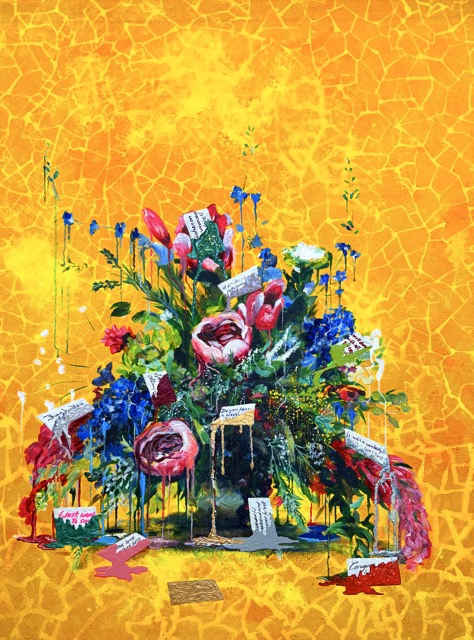
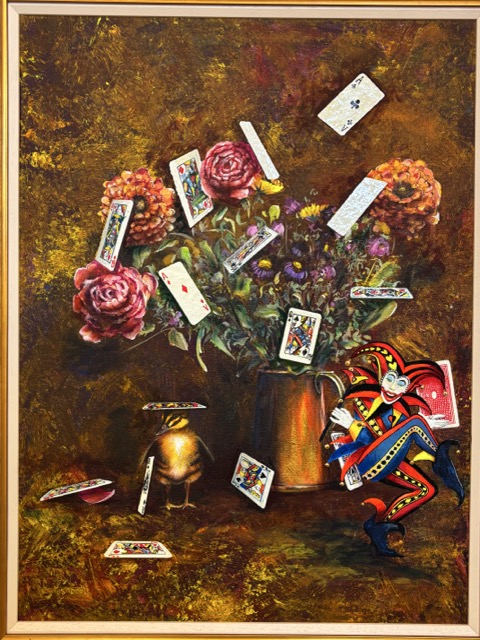
In Say It With Flowers, Damian O’Connor reimagines the still life as an emotional document where every bloom speaks and every message matters. A vivid bouquet erupts from the canvas, painted with intensity and delicacy, but it is the handwritten message cards nestled among the petals that shift the meaning entirely.
These notes are not decorative, they are personal. Some are legible, others half-concealed or emotionally smudged. “Do you even care?” “Just had to say…” “I meant to tell you…” Each one is a fragment of a conversation that didn’t happen or couldn’t. Here, flowers take on the burden of language: saying thank you, I’m sorry, I miss you, I can’t.
The crackled yellow background feels sun-soaked yet fragile, like old porcelain or a weathered letter. Paint drips from the stems as if words and emotions are bleeding into the canvas. This is not a celebration, it is a confession wrapped in roses and violets.
Say It With Flowers is a deeply contemporary work disguised as a classic form. It captures the moments when our feelings are too large for speech and so we send flowers instead.
Koi
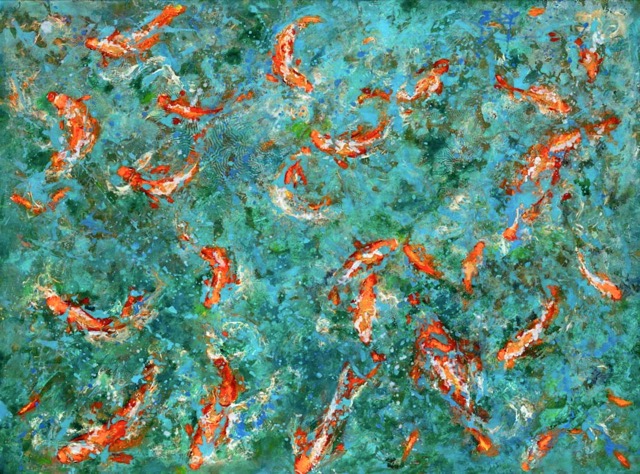
In Koi, Damian O’Connor transforms a tranquil pond into a portrait of individuality and purpose. Against a shifting expanse of turquoise and jade, each fish moves with deliberate grace, not as part of a shoal but as a singular being guided by its own unseen current. Their paths cross, intertwine then separate again, a visual echo of lives that touch and move on.
The painting is alive with light and texture: flecks of gold shimmer beneath translucent layers of blue and green, suggesting both depth and reflection. The koi themselves gleam in bursts of orange and white, their presence electric against the cool calm of the water. Every mark feels intentional, every movement self-assured.
Here, O’Connor resists the idea of harmony through sameness. Instead, Koi becomes a meditation on selfhood, on the mystery of what compels each creature and each person to keep moving in their own direction. The result is serene yet charged, a still surface concealing countless private journeys beneath.
Koi
In Koi, Damian O’Connor transforms a tranquil pond into a portrait of individuality and purpose. Against a shifting expanse of turquoise and jade, each fish moves with deliberate grace, not as part of a shoal but as a singular being guided by its own unseen current. Their paths cross, intertwine then separate again, a visual echo of lives that touch and move on.
The painting is alive with light and texture: flecks of gold shimmer beneath translucent layers of blue and green, suggesting both depth and reflection. The koi themselves gleam in bursts of orange and white, their presence electric against the cool calm of the water. Every mark feels intentional, every movement self-assured.
Here, O’Connor resists the idea of harmony through sameness. Instead, Koi becomes a meditation on selfhood, on the mystery of what compels each creature and each person to keep moving in their own direction. The result is serene yet charged, a still surface concealing countless private journeys beneath.
Swanlight
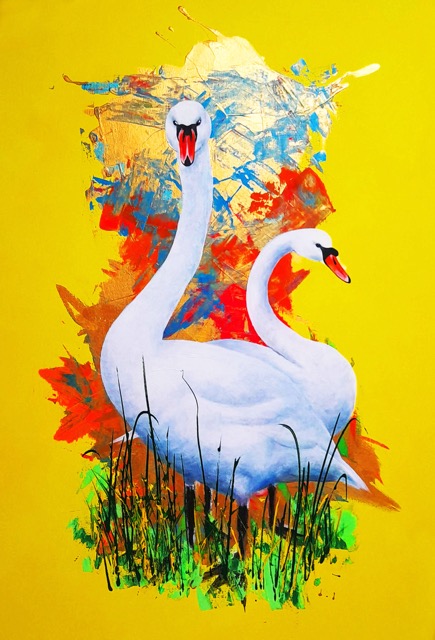
Damian O’Connor’s Swanlight is a commanding work that captures the delicate balance between serenity and instinct. Against a backdrop of bold expressive abstraction layered with metallic leaf, cadmium reds, cobalt blues and flashes of gold, two white swans emerge: poised, elegant and fiercely present. One bows with quiet grace while the other lifts its head in defiance, beak open, asserting its space.
The radiant yellow ground and painterly explosions reframe the swans not as pastoral ornaments but as modern symbols of duality, vulnerability and strength, order and disruption. Rendered in O’Connor’s recognisable style, the piece challenges traditional wildlife painting with a vivid contemporary aesthetic.
At 122 x 91 cm and housed in a bespoke frame, Swanlight is both a visual anchor and a talking point, ideal for a collector seeking a singular work with emotional depth and a powerful physical presence.

Garden of Good Intentions
In Garden of Good Intentions, Damian O’Connor delivers a blistering and poetic indictment of war’s absurdity wrapped in the unsettling comfort of childhood iconography. At the heart of the scene a rag doll and a toy clown stand side by side, small hands gripping a weapon they cannot understand. Their painted smiles belie the horror they carry as they become unwilling symbols in a theatre of inherited violence.
A teddy bear watches mutely. Two adult mallards, lifelong mates, guide their ducklings through water littered with playing cards, playing the game of life and death. The fish below watch. Overhead birds and ribbons whirl in a tree that bears oranges and secrets. Hidden among the foliage are folded paper messages in foreign languages, silent impassioned pleas to stop, to understand, to listen. At the centre a white fantail dove lifts in vain, struggling to rise amid celebration and collapse.
O’Connor’s bold saturated palette intensifies the contradiction. It is beautiful. It is tragic. It is absurd. Garden of Good Intentions is not merely a work of symbolic storytelling, it is a protest piece, a lament and a confrontation. In every detail there is yearning: for peace, for protection, for the innocence that cannot be restored once it has been weaponised.
At 98 x 160 cm or 3’3” x 5’3”, presented in a bespoke frame, this painting stands as a powerful visual requiem for a world that too often places weapons in the hands of the young, real or symbolic, and calls it play.
Love’s Trick
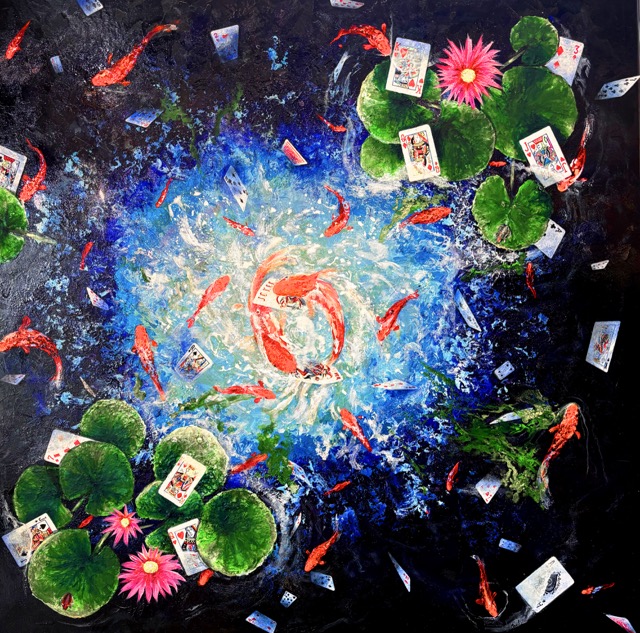
In Love’s Trick, Damian O’Connor conjures a universe where fate, love and chance collide beneath the surface of a shimmering pond. Koi dart through a swirling field of water lilies, floating playing cards and radiant light but two stand apart. At the centre, a pair of koi, moving together yet distinct, each jostle with a joker card, the rarest and most unpredictable symbol in the deck. There are only two in a full pack and here, improbably, they meet.
The jokers shift the entire dynamic. This is not just a beautiful scene of nature and luck, it is a visual metaphor for the extraordinary: the moment when two rare forces find each other. It is fate but more playful. It is love but stranger. It is a chance of a lifetime.
Around them, cards scatter through the water, Queens and Kings among them, unmoored. Even those with crowns cannot resist the pull of the current. Lilies bloom briefly, brilliantly. The water churns with colour, mystery and transformation.
O’Connor’s control of detail and chaos is masterful. His koi are lively yet ancient, the water alive with suggestion, the cards acting as both divination and debris.
At 128 x 128 cm / 4’2” x 4’2”, Love’s Trick is a lush, layered and philosophically rich work. It invites the collector to reflect not just on destiny but on the strange rare moments when everything aligns and you know it.
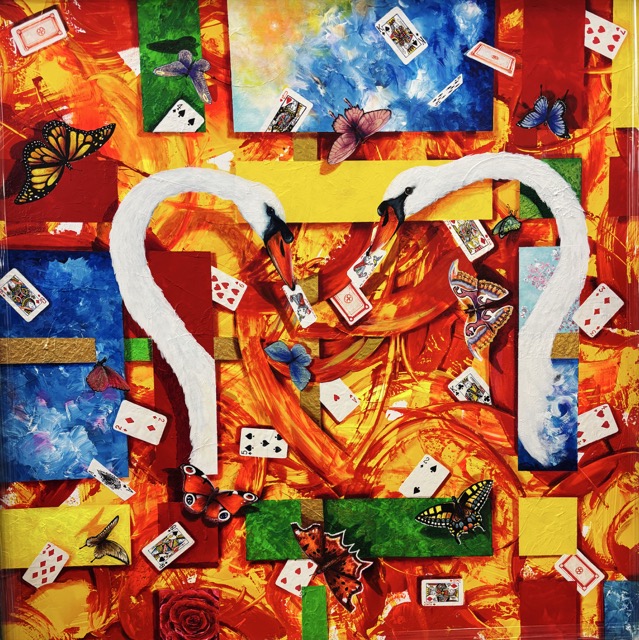
Love’s Game
In Love’s Game, Damian O’Connor creates a rich theatrical meditation on connection, fate and the unpredictability woven into even the most committed bonds. Two swans, creatures known to mate for life, face one another across a vivid geometric landscape of colour, cards and butterflies. But instead of the expected token of romance or devotion, each swan holds a joker in its beak.
It is a visual twist that upends expectation. The jokers suggest that within lifelong love there is always play, mystery, chaos and risk. In O’Connor’s world, devotion is not sterile, it is wild, vibrant and occasionally absurd.
Cards drift across the canvas, suspended, falling, embedded in the painted ground. Butterflies flutter through the colour fields, echoing transformation and fleeting beauty. Red, gold, blue and green blocks slice the canvas into zones of emotion, memory and chance. A red rose blooms quietly beneath it all, anchoring the chaos with a whisper of tradition.
Everything here is symbolic but nothing is fixed. Love’s Game is about what happens after certainty. About what remains when passion is no longer dramatic but shared. It is joyful, complex and honest.
At 122 x 122 cm and housed in a bespoke frame, this piece is a celebration of not just love’s strength but love’s unpredictability, its oddities, its private humour, its deep and permanent imperfection.
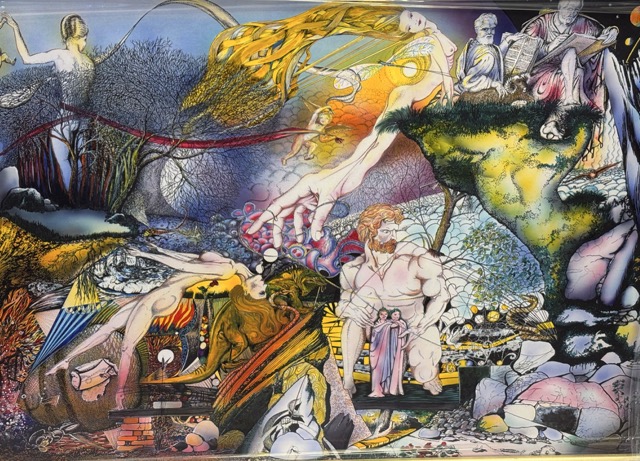
Gods Watch
In Gods Watch, Damian O’Connor assembles a hallucinatory epic of strength, seduction, history and divine scrutiny. The canvas becomes a stage where the classical and the contemporary collide. A colossal male figure, muscular and vulnerable, is surrounded by fractured symbols of judgment, temptation and transformation. To his left, a reclining female figure floats, unreachable or already fallen. Above, deities, scribes and cosmic beings observe, record or manipulate the unfolding drama.
A glowing hand descends, echoing Michelangelo’s Creation of Adam, but here the gesture seems less about birth and more about interference or choice. Golden hair weaves like flame across the sky, linking one plane of existence to another. Elsewhere, cracked eggs, crumbling structures and fractured landscapes speak of broken beginnings and mythologies reinterpreted.
This is not linear storytelling. It is memory, dream and archetype colliding in electric detail. O’Connor weaves the chaos with absolute control: precise linework, layered textures and a palette that veers from celestial to infernal.
Set in a hand-finished frame that echoes the grandeur of the composition, Gods Watch is a monumental psychological landscape, part prophecy part confession and wholly original.
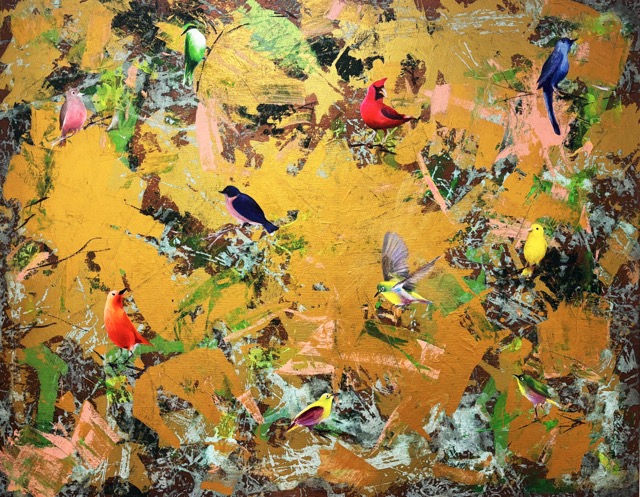
Golden Garden
In Golden Garden, Damian O’Connor captures a moment of quiet intensity where colour becomes conversation. Against an abstract field of gilded ochre, rose and moss, a dozen birds rest or hover, each perfectly painted, poised and isolated in space yet clearly aware of one another. They do not sing but the canvas hums with the suggestion that they might.
The background pulses with energy, a spontaneous painterly tangle of marks and textures, both raw and refined. The brushwork evokes forest floor and morning light without ever settling on literal form. The birds, by contrast, are rendered in exquisite detail: crimson, saffron, violet, emerald, flame. They offer contrast, clarity, punctuation.
Here, nature is not romanticised but revealed in its codes. These birds are not decorative, they are signs, messengers, companions, watchers. Each one appears mid-thought or mid-flight or mid-withdrawal.
O’Connor invites the viewer to find pattern in the scatter. To listen, not just look. Golden Garden is an evocative painterly meditation on presence, perception and unseen communication. A contemporary reflection of wild order within apparent abstraction.
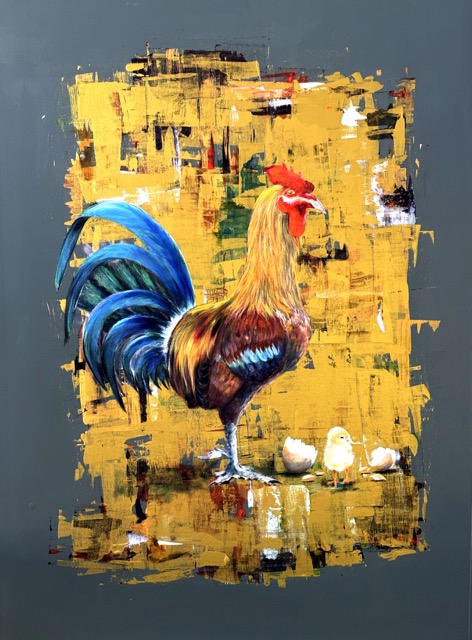
First Light
In First Light, Damian O’Connor distils the moment between ending and beginning. A lone rooster towers at centre stage, resplendent in feathers of flame, indigo and ash, standing sentinel over the fragile aftermath of birth. At his feet, a newly hatched chick peers into the world, eyes open, alone but not unobserved.
The broken shell is still fresh. The paint around it is layered and scraped like memory, worn in places as though time has already passed. The background hums with ochres and raw marks, evoking both the straw-flecked ground of the farm and something more abstract, perhaps the history we inherit or the mess from which we emerge.
There is no mother in sight, no warmth but light. And yet there is strength here. The rooster doesn’t strut. He watches. He waits. He knows.
O’Connor reminds us that not all protection is loud. Some guardianship is quiet, rooted and ancient. A life has begun. That is reason enough to stand still.
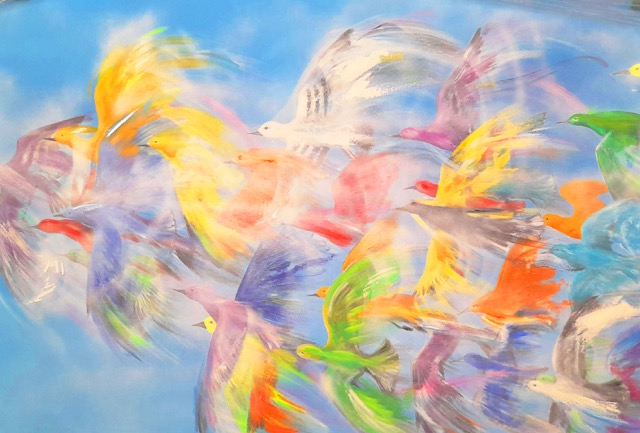
Instinct
In Instinct, a vivid flock of birds explodes across the canvas in a flurry of colour and movement. There is urgency in their flight, each wingbeat painted with energy and tension.
Though they appear to be of the same species, each bird carries its own shape, shade and momentum, a reminder that even in a crowd individuality remains. This is not graceful migration, it is fearful frantic motion, a nervous scatter in response to unseen danger. Yet beneath the chaos lies something more profound.
We often assume a flock has a leader. But the truth is far more democratic and chaotic. Each bird responds only to those around it, creating the illusion of a single directed movement when in reality the flock itself is the decision-maker. The result is a kind of collective instinct, a choreography of survival.
Instinct captures this wild intelligence and restless beauty. It asks not just where we are going but whether we ever truly know, or if, like these birds, we are simply carried forward by the movement of those around us.
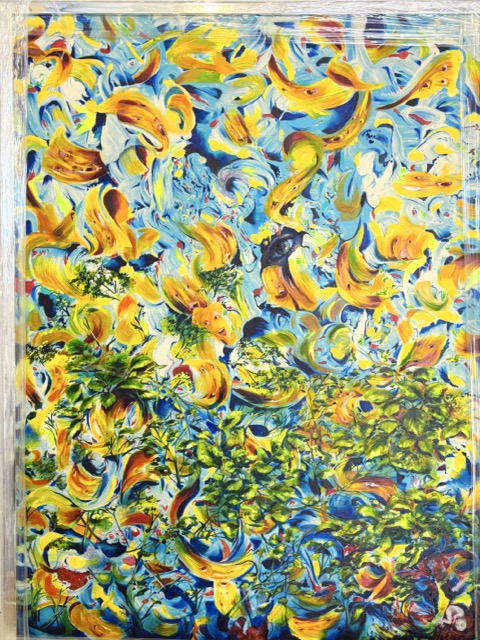
Mulberry Bush
In Mulberry Bush, Damian O’Connor transforms the nursery rhyme refrain into a sweeping symbolic map of life itself. From the lower right corner, a newborn emerges, small and fragile, the start of everything, before being swept into a swirling vortex of colour, pattern and encounter.
The composition spins with vivid arcs of yellow, blue and orange, their movement both joyous and turbulent. Faces and figures appear fleetingly in the dance, some close and some distant, mirroring the way people enter our lives briefly, leaving their mark before moving on. At the centre, a singular unblinking eye watches over it all, not judging, not intervening, but bearing witness to the entire cycle.
This is not a literal mulberry bush, but an abstracted cosmos where the “bush” becomes the tangled weave of experience, growth, repetition, renewal, chaos and delight. The green foliage near the base is lush yet untamed, grounding the work in nature’s persistence. Above, the brushwork lifts into pure movement, like time accelerating the further we go.
Mulberry Bush is both playful and profound, a riot of life’s energies overseen by something larger, quieter and constant. It is a reminder that no matter how dizzying the spin, each of us is part of the same great turning.
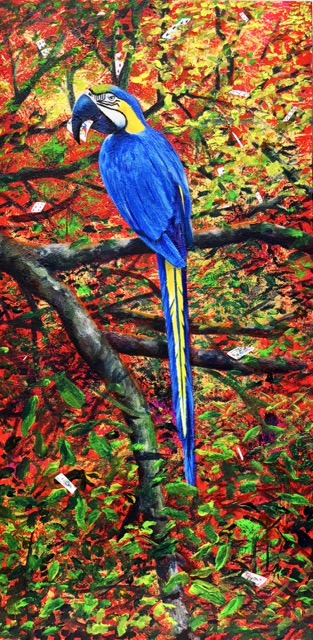
Wild Card
In Wild Card, Damian O’Connor continues his visual dialogue with chance, love and the unpredictable forces that bind them. A parrot, radiant in cobalt and gold, perches amid a tangle of autumnal branches, its plumage cutting sharply through the surrounding blaze of reds and greens. In its curved beak it holds the joker, the artist’s recurring emblem of unpredictability, folly and truth.
The joker appears throughout O’Connor’s work: held by swans, jostled by koi, drifting through ponds and skies. It is never merely a card but a reminder that all order depends on risk, that love, devotion and even identity require play to remain alive. Here, the parrot becomes both trickster and guardian, balancing brilliance with fragility.
Scattered cards glint between leaves, as if nature itself has joined the game. The parrot’s gaze, intelligent and unflinching, meets the viewer with quiet challenge: who really holds the power, the creature, the card or chance itself?
Lush, layered and alive with colour, Wild Card captures the tension between control and surrender, certainty and the wild necessity of risk.
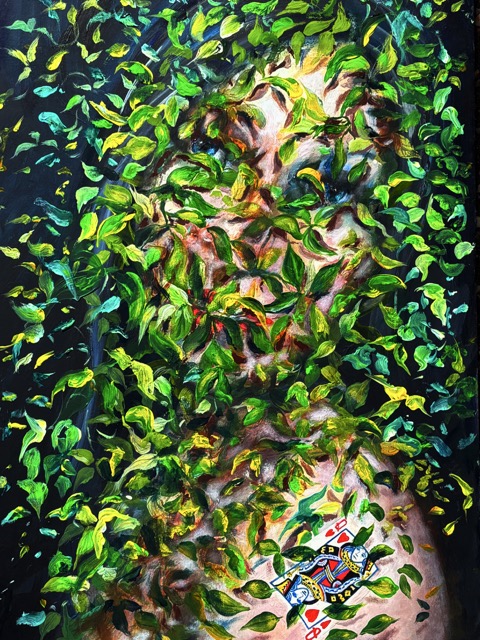
Hidden Heart
In Hidden Heart, Damian O’Connor fuses portraiture with the natural world to explore the fragile boundary between what is revealed and what is kept unseen. A face materialises from a thicket of leaves, not emerging fully but suspended in a moment between concealment and recognition. The foliage encircles her like both armour and entrapment, a living force that protects while quietly reclaiming.
Amid this green intricacy, a single emblem draws the eye: the Queen of Hearts, pressed close to the skin. It is both adornment and warning, the universal symbol of love, authority and risk. O’Connor positions it as the pulse within the painting, the still point around which emotion gathers.
His brushwork shifts between calm and restlessness, fine lines blur into organic movement while light flickers through the canopy like thought through memory. Hidden Heart invites us to consider how identity, desire and nature entwine, how beauty conceals as much as it reveals and how the heart, even hidden, refuses silence.